- Dec 3, 2025
Nourish Your Neurons: A Faith-Driven Guide to Boosting Brain Health During Menopause
Because God didn’t design your mind to slow down just because your hormones are shifting.
Hey Midlife Warriors, if you’ve been walking into rooms and forgetting why, rereading the same line three times, or losing your train of thought mid-sentence, take a breath. You’re not “losing it.” You’re not alone. And you’re definitely not stuck this way.
Research shows that during menopause, women experience an average 30% drop in brain energy due to declining estrogen, a major physiological shift, yet not one that destroys cognitive ability. Your brain is still brilliant; it just needs a different kind of support in this season.
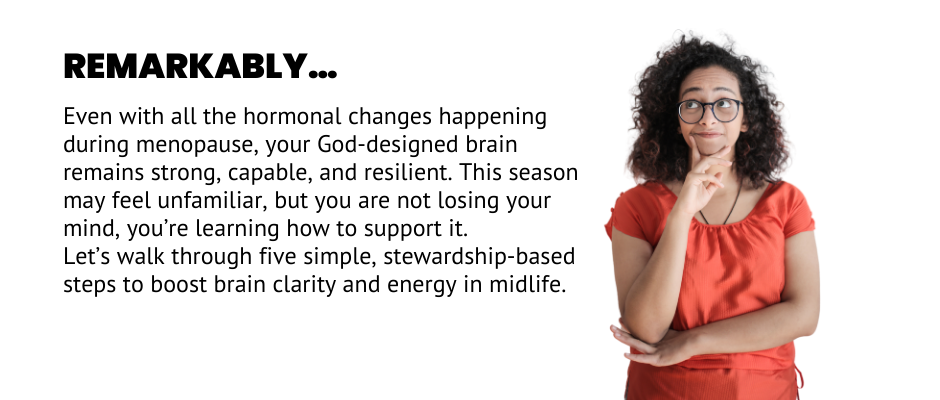
Today, we’re breaking down exactly what’s happening in your brain and, more importantly, what you can do to strengthen memory, clarity, and focus through menopause, naturally and sustainably.
Before we dive in:
If you want a simple, ready-to-use plan that supports brain health, energy, fat loss, and hormone balance, grab my Midlife Reset Guide, your go-to resource for fueling your body and brain well.
👉 Grab it here: Midlife Reset Guide (Free Download)
What’s Actually Happening in Your Brain During Menopause?
Menopause affects more than hot flashes and mood shifts. Inside your brain, estrogen plays a starring role:
The hypothalamus (your temperature control center) becomes sensitive → hello hot flashes.
The brain stem (your sleep-wake regulator) gets disrupted → cue insomnia and 2 a.m. staring contests with the ceiling fan.
The amygdala + hippocampus (your emotional and memory centers) feel the change → mood swings, anxiety, forgetfulness.
This drop in estrogen is also linked to the type of bioenergetic decline that researchers associate with increased Alzheimer’s risk later in life. That doesn’t mean menopause = Alzheimer’s. But it does mean midlife is the most powerful window for prevention.
Understanding this gives you your power back.
You’re not at the mercy of your hormones; you’re equipped to support your brain in this season with wisdom, strategy, and stewardship.
5 Faith-Aligned Steps to Boost Brain Health During Menopause
1. Eat Brain-Boosting Foods: Fuel the Machine God Designed
Your brain is hungry, especially during menopause. Nourishing it well is one of the fastest ways to support clarity, focus, and long-term cognitive health.
A Mediterranean-inspired eating pattern, rich in healthy fats, whole grains, legumes, and phytoestrogen foods, has been proven in multiple studies to support brain energy and hormonal balance.
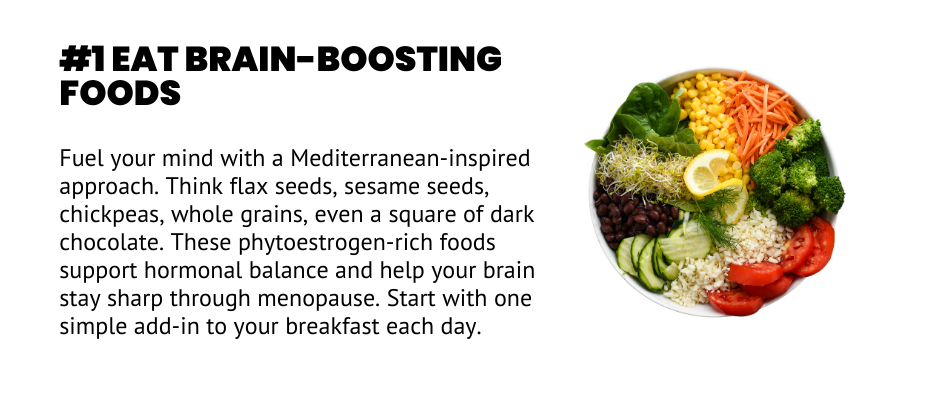
Here are midlife-friendly foods that help stabilize cognition:
Flax seeds (lignans to support hormonal balance)
Sesame seeds (minerals for cognitive function)
Dark chocolate (antioxidants + a little joy)
Chickpeas + lentils (mood-stabilizing, protein-rich)
Whole grains (steady brain fuel)
Simple Action: Add 1–2 phytoestrogen-rich foods to your breakfast or lunch daily.
A sprinkle here. A spoonful there. Stewardship in motion.
2. Manage Stress: Cortisol + Estrogen Are Tightly Connected
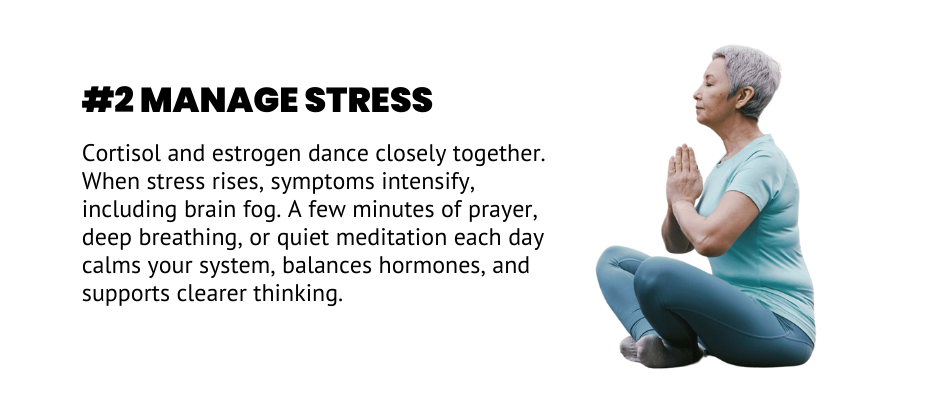
Stress during menopause hits differently. Elevated cortisol can intensify hot flashes, worsen brain fog, spike cravings, and sabotage sleep, all of which directly impact your cognitive health.
Just 5 minutes of daily nervous system regulation can strengthen hormone balance and improve brain clarity.
Try:
Slow breathing (4–4–4 pattern)
A short prayer pause
Five minutes of quiet meditation
Scripture-based reflection
Small habits, big impact. Stewardship isn’t grand gestures; it’s consistency.
3. Prioritize Sleep: The Foundation of Cognitive Health
Sleep is your brain’s nightly housekeeping. During menopause, it’s harder, but also more essential.
Poor sleep affects:
Memory
Mood
Focus
Hormonal rhythm
Your ability to handle stress
What to do:
Pick one habit and practice it nightly:
Consistent bedtime
15-minute wind-down routine
No screens 30 minutes before bed
Cooling bedroom environment
Your brain will thank you, and your morning self will, too.
4. Nourish Your Brain with Omega-3s, Antioxidants, and B-Vitamins
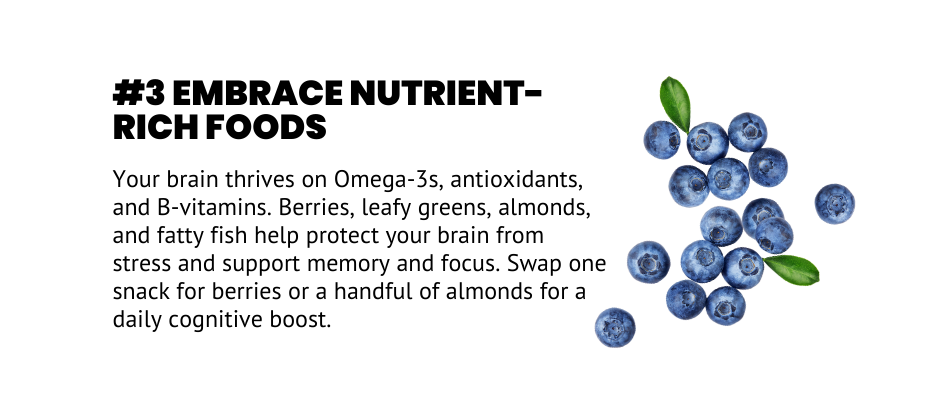
These nutrients directly impact cognitive function and emotional stability.
Try adding:
Fatty fish or flaxseed (Omega-3s)
Berries daily (antioxidants to protect brain cells)
Almonds or walnuts (healthy fats for brain structure)
Leafy greens (B vitamins for neurotransmitter production)
Simple Swap: Replace one daily snack with a handful of berries or almonds.
Easy. Delicious. Brain-building.
5. Move Your Body: Exercise is the Ultimate Brain Booster
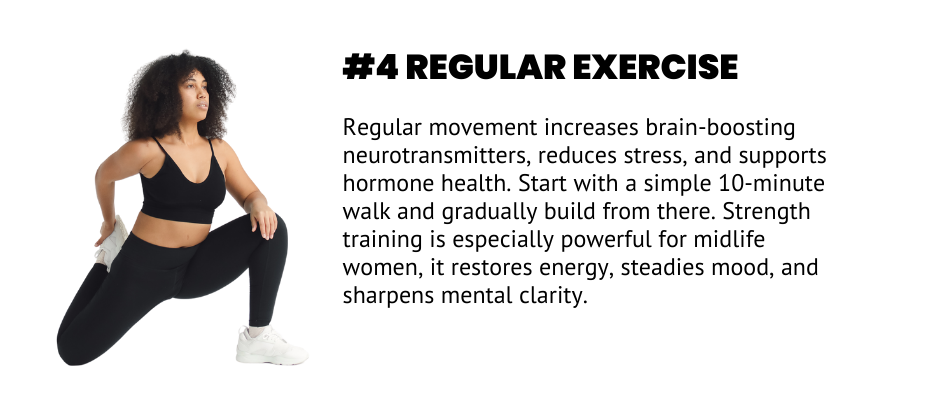
Exercise increases blood flow to the brain, supports hormone regulation, boosts serotonin and dopamine, and improves sleep, all things your midlife brain craves.
You don’t need 60-minute workouts, hardcore cardio, or complicated routines.
Start with:
A 10-minute daily walk
2–3 strength workouts per week
Strength training is especially helpful because it balances hormones, improves mood, and supports metabolic health, all crucial for brain clarity.
Small steps build big momentum.
The Faith-Centered Upshot
Ladies, your brain is not failing you.
This season is not a decline; it's a transition.
God designed your mind to be strong, adaptable, and resilient. Menopause doesn’t change that; it simply calls you into a deeper level of stewardship.
By nourishing your body, supporting your hormones, fueling your brain, and embracing daily habits that bring order back to your mind, you can walk through this season with clarity, peace, and renewed strength.
Want a Simple Place to Start?
Download my Midlife Reset Guide.
It pairs perfectly with everything you just learned and helps you:
Eat in a way that supports brain clarity
Build strength (your core premise!)
Reduce stress
Improve sleep
Create consistent habits
Ease menopause symptoms
Stabilize energy
👉 Click here to grab your free Midlife Reset Guide, your first step to clearer thinking and stronger days.
Curious About Coaching or Want Personalized Support?
If this message hits home, if you’re tired of feeling foggy, overwhelmed, or unlike yourself, I’d love to support you.
You can ask me questions or share what you’re struggling with through my coaching inquiry form.
👉 Submit your questions here, and I’ll personally reply...
(No pressure, no commitment, just real answers and support.)
~Coach Ehren
Sources and Further Reading
https://www.alz.org/media/documents/facts-and-figures-2018-r.pdf
Brinton RD, Yao J, Yin F, Mack WJ, Cadenas E. Perimenopause as a neurological transition state. Nat Rev Endocrinol. 2015 Jul;11(7):393-405. doi: 10.1038/nrendo.2015.82. Epub 2015 May 26. PMID: 26007613; PMCID: PMC9934205.
Yue X, Lu M, Lancaster T, Cao P, Honda S, Staufenbiel M, Harada N, Zhong Z, Shen Y, Li R. Brain estrogen deficiency accelerates Abeta plaque formation in an Alzheimer's disease animal model. Proc Natl Acad Sci U S A. 2005 Dec 27;102(52):19198-203. doi: 10.1073/pnas.0505203102. Epub 2005 Dec 19. PMID: 16365303; PMCID: PMC1323154.
Mosconi L, Berti V, Quinn C, McHugh P, Petrongolo G, Varsavsky I, Osorio RS, Pupi A, Vallabhajosula S, Isaacson RS, de Leon MJ, Brinton RD. Sex differences in Alzheimer risk: Brain imaging of endocrine vs chronologic aging. Neurology. 2017 Sep 26;89(13):1382-1390. doi: 10.1212/WNL.0000000000004425. Epub 2017 Aug 30. PMID: 28855400; PMCID: PMC5652968.
Perimenopause and the emergence of an Alzheimer's bioenergetic phenotype in the brain and periphery – https://journals.plos.org/plosone/article?id=10.1371/journal.pone.0185926
Increased Alzheimer's risk during the menopause transition: A 3-year longitudinal brain imaging study - https://journals.plos.org/plosone/article?id=10.1371/journal.pone.0207885
Mosconi L, Berti V, Quinn C, McHugh P, Petrongolo G, Varsavsky I, Osorio RS, Pupi A, Vallabhajosula S, Isaacson RS, de Leon MJ, Brinton RD. Sex differences in Alzheimer risk: Brain imaging of endocrine vs chronologic aging. Neurology. 2017 Sep 26;89(13):1382-1390. doi: 10.1212/WNL.0000000000004425. Epub 2017 Aug 30. PMID: 28855400; PMCID: PMC5652968.
Increased Alzheimer's risk during the menopause transition: A 3-year longitudinal brain imaging study - https://journals.plos.org/plosone/article?id=10.1371/journal.pone.0207885
Sperling RA, Karlawish J, Johnson KA. Preclinical Alzheimer's disease-the challenges ahead. Nat Rev Neurol. 2013 Jan;9(1):54-8. doi: 10.1038/nrneurol.2012.241. Epub 2012 Nov 27. PMID: 23183885; PMCID: PMC3643203.
Rocca WA, Bower JH, Maraganore DM, Ahlskog JE, Grossardt BR, de Andrade M, Melton LJ 3rd. Increased risk of cognitive impairment or dementia in women who underwent oophorectomy before menopause. Neurology. 2007 Sep 11;69(11):1074-83. doi: 10.1212/01.wnl.0000276984.19542.e6. Epub 2007 Aug 29. PMID: 17761551.
Bove R, Secor E, Chibnik LB, Barnes LL, Schneider JA, Bennett DA, De Jager PL. Age at surgical menopause influences cognitive decline and Alzheimer's pathology in older women. Neurology. 2014 Jan 21;82(3):222-9. Doi: 10.1212/WNL.0000000000000033. Epub 2013 Dec 11. PMID: 24336141; PMCID: PMC3902759.
Faubion SS, Kuhle CL, Shuster LT, Rocca WA. Long-term health consequences of premature or early menopause and considerations for management. Climacteric. 2015;18(4):483-91. doi: 10.3109/13697137.2015.1020484. Epub 2015 Apr 7. PMID: 25845383; PMCID: PMC4581591.
https://www.menopause.org/docs/default-source/2017/nams-2017-hormone-therapy-position-statement.pdf
Vetrani C, Barrea L, Rispoli R, Verde L, De Alteriis G, Docimo A, Auriemma RS, Colao A, Savastano S, Muscogiuri G. Mediterranean Diet: What Are the Consequences for Menopause? Front Endocrinol (Lausanne). 2022 Apr 25;13:886824. doi: 10.3389/fendo.2022.886824. PMID: 35546996; PMCID: PMC9084275.
Barrea L, Pugliese G, Laudisio D, Colao A, Savastano S, Muscogiuri G. Mediterranean diet as a medical prescription in menopausal women with obesity: a practical guide for nutritionists. Crit Rev Food Sci Nutr. 2021;61(7):1201-1211. doi: 10.1080/10408398.2020.1755220. Epub 2020 Apr 24. PMID: 32329636.
Quattrini S, Pampaloni B, Gronchi G, Giusti F, Brandi ML. The Mediterranean Diet in Osteoporosis Prevention: An Insight in a Peri- and Post-Menopausal Population. Nutrients. 2021 Feb 6;13(2):531. doi: 10.3390/nu13020531. PMID: 33561997; PMCID: PMC7915719.